


The Protea – remarkable and captivating

Eco-Rangers on a project
In the Helderberg, we are blessed to have many species of the protea family growing in the wild and in our gardens. With the cold, wet weather, the subject of the Protea made for a fascinating topic to share with our Genet group. So often we walk in the outdoors and come across these magnificent plants, however, do we really know which species we are looking at?
Today our children were able to spend time learning about the various species of Protea. And for some tactile work suited to this age group, we had a couple of examples showing the variations of colour, texture of leaves and petals. To add to this, the children will have been able to see the different shapes of the flowers and the leaves. Following a few moments of observation, the children each created their very own picture with a protea and glittery sun bird. This proved to be a fabulous activity for the children and parents. Lots of sticking, pasting, cutting, gluing and most importantly . . . laughter and smiles. A perfect activity for our 3 – 5 year old children with many excellent pictures completed.

Protea Leucospermum Reflexum
Where does the name come from?
The Protea was named after the Greek sea god, Proteus. Proteus was known for his ability to change his appearance at will. The Protea itself blooms under many different guises hence the number of varieties. To add to this, the Proteaceae family is known as an ancient flower. There is evidence of protea life being around some 300 million years ago. It is no wonder Botanist Carl Linnaeus decided to give the protea this name.
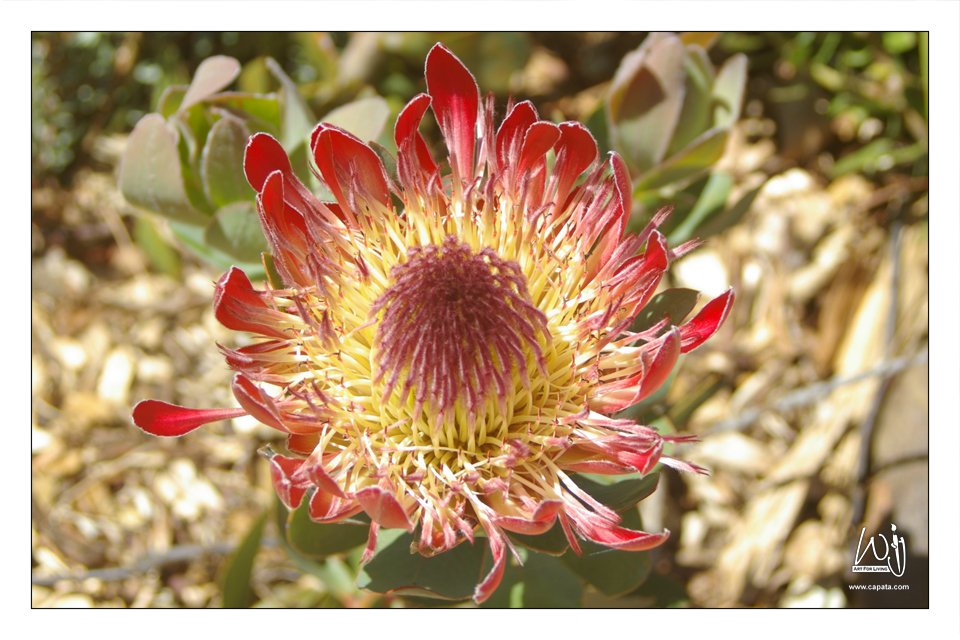
Protea Eximia
Proteas are most often found in South Africa. In actual fact, there are over 300 species in South Africa with 92% found within the fynbos belt of the Cape Floral Kingdom. They are however, found growing wild outside of our country. There is one species found on Mt Kenya and another in Madagascar. Further afield there is another branch of the protea family which is found in South-West Australia, Eastern Asia and South America.
Living where we do, we have an abundance of these beautiful plants. Why not grow some in your garden and attract some of the gorgeous sugar birds. Of course, the best place to see them is while out walking in the outdoors. The Helderberg Nature reserve in September is a must. Take your camera, a pencil and paper or some paints . . . . and spend some time with these amazing plants. If you have time, why not visit the Cedarberg or Table Mountain.
For those interested in identifying the protea:
http://www.helderbergnaturereserve.co.za/nature/flora/protea-identification/


